Book a Demo

Finance AI Feature

Data preparation AI that turns ERP exports into reporting-ready datasets.

Finance AI Workspace can work with summary-level trial balances directly, or use Data Preparation AI to reduce raw ERP exports into validated summary datasets before reporting.

Product workflow previewFinance AI Workspace dashboard with monthly close, estimate, financial analysis, IFRS 18, and reports

Problem

What finance teams are trying to fix

Finance teams often receive ERP data at the wrong level of detail. Some exports are ready-to-use trial balances, while others contain millions of journal or invoice rows that are too detailed for monthly reporting, consolidation, or variance analysis.

Why it matters

Why this workflow deserves structure

The workspace should not force every customer through a heavy preparation step. Summary trial balances can move directly to Account Mapping AI, while raw ERP exports get prepared only when the data actually needs it.

Before / After

What changes when the workflow is structured.

BeforeAfter
Millions of journal rowsReporting-ready summary dataset
Unknown source grainDetected summary or raw upload path
Manual data preparationAI-assisted profiling and aggregation
Reporting from uploadsReporting from Published Datasets

Typical results

Credible outcomes without hard promises.

Finance teams typically use Data Preparation AI to:

  • reduce transaction-level exports before reporting
  • validate source totals against prepared totals
  • publish reusable datasets
  • keep Monthly Close summary-data-first

How it works

A controlled workflow from source data to reviewed output.

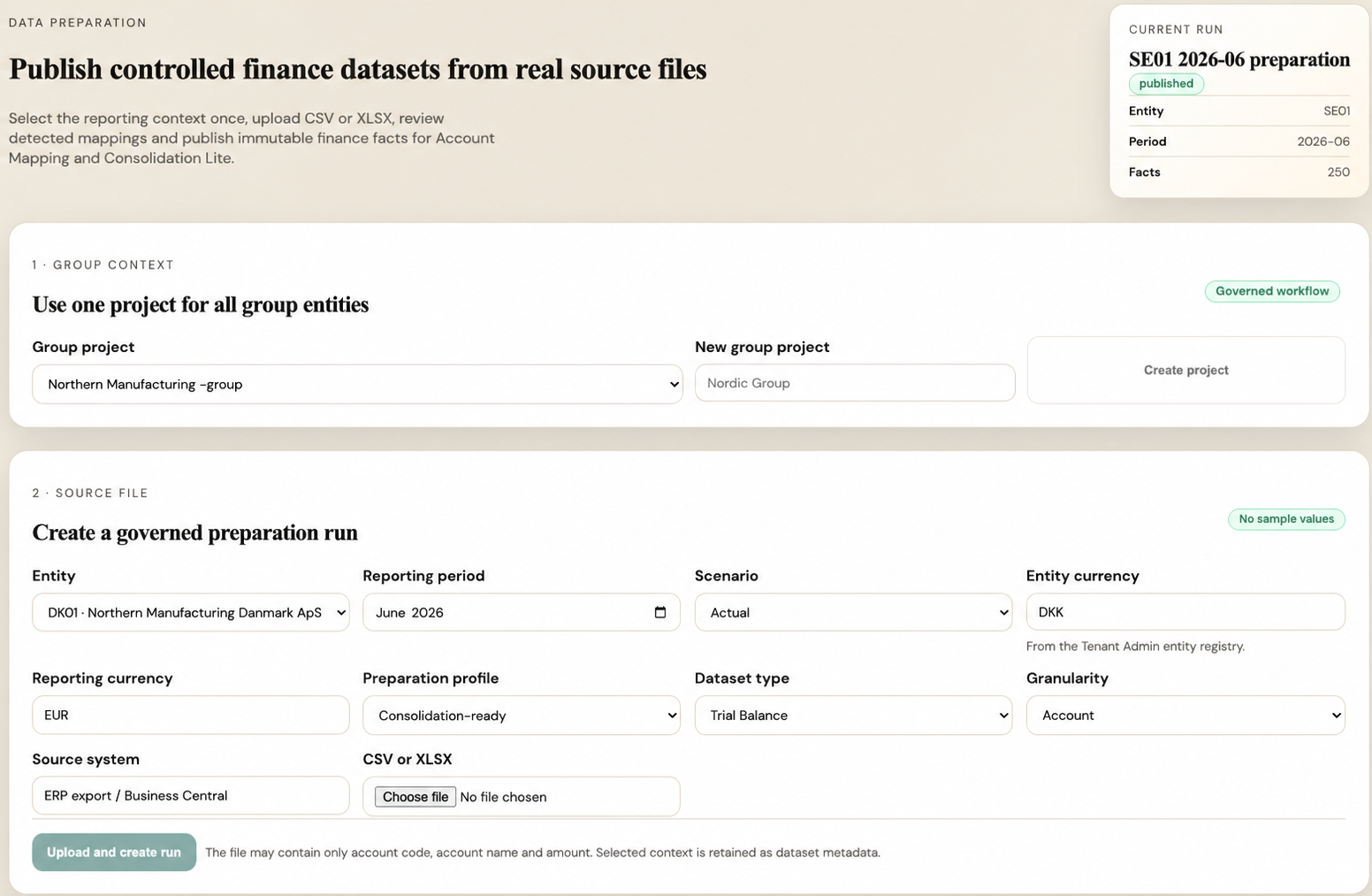
01Upload ERP export
02Detect summary or raw data
03Profile ERP and dimensions
04Aggregate to reporting grain
05Validate totals
06Publish dataset

Key capabilities

Built around the work controllers and CFOs repeat every month.

Summary and raw ERP upload handling

Automatic source grain detection

ERP profile and dimension detection

Aggregation level recommendation

Data quality validation

Lineage without permanent raw row storage

Published dataset lifecycle

Typical finance workflow

The real monthly process this feature is designed to support.

Step 1

Summary upload

A monthly trial balance with period, entity, account, amount, currency, and key dimensions skips Data Preparation AI and continues to Account Mapping AI.

Step 2

Raw ERP export

A transaction-level export with journal, voucher, or invoice rows triggers Data Preparation AI before reporting.

Step 3

Profiling

The system detects ERP, language, currency, dimensions, row count, source grain, and likely reporting fields.

Step 4

Aggregation

Raw data is reduced by month, entity, account, cost center, project, and selected dimensions.

Step 5

Validation

Totals, signs, fiscal periods, currencies, duplicate rows, and mapping handoff readiness are checked.

Step 6

Dataset publish

Only a published dataset feeds Monthly Close, Consolidation Lite, Variance Analysis, Estimate, and Management Pack.

Related workflows

Shows how this feature connects to the broader finance process.

  1. 01ERP Upload
  2. 02Account Mapping AI
  3. 03Finance Semantic Model
  4. 04Published Dataset
  5. 05Finance Fact Store
  6. 06Finance Cube
  7. 07Monthly Close

Screenshots

Product views that show the workflow, not just a feature list.

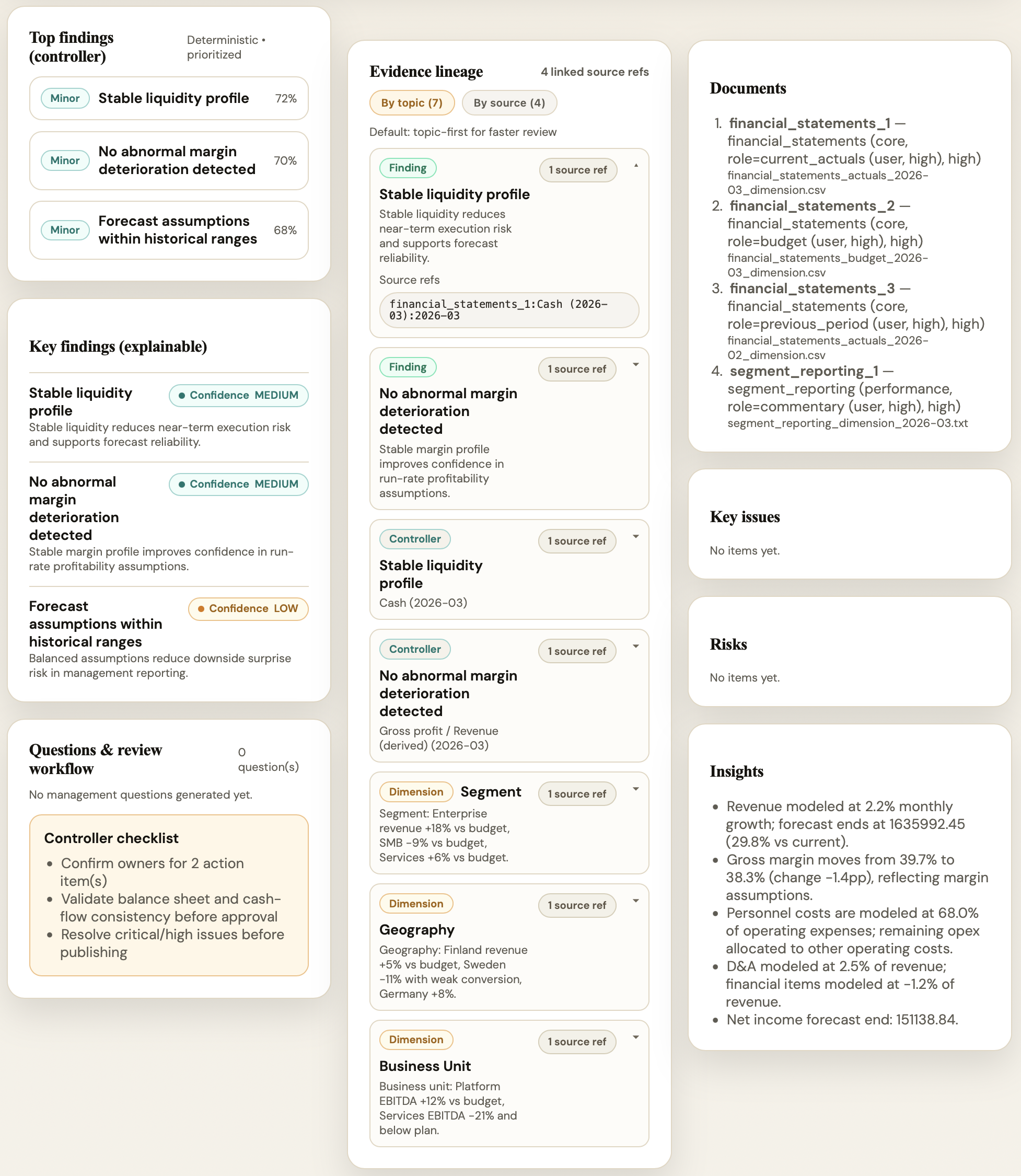
Actual product viewFinance AI Workspace dashboard with monthly close, estimate, financial analysis, IFRS 18, and reports
Actual product viewEvidence audit view showing sources, confidence, and traceability controls

Who is it for

Designed for finance teams accountable for the monthly truth.

  • CFOs
  • Group Controllers
  • Financial Controllers
  • Finance Managers
  • FP&A teams
  • Accounting Managers

Inputs & roadmap

Start with practical finance inputs. Direct system integrations are roadmap items.

Available input paths

  • ERP exportsInput
  • ExcelInput
  • CSVInput

Planned integrations

  • SAPPlanned
  • OraclePlanned
  • NetSuitePlanned
  • Microsoft DynamicsPlanned
  • AAROPlanned
  • OneStreamPlanned
  • Power BIPlanned

Planned integrations are based on customer demand and implementation priorities.

FAQ

Common questions about Data Preparation AI.

Is Data Preparation AI required?

No. It is optional. If the upload is already a summary trial balance, the workspace can skip Data Preparation AI and continue directly to Account Mapping AI.

When is Data Preparation AI useful?

It is useful when a customer uploads transaction-level ERP exports, such as journal entries, voucher rows, invoice lines, or other detailed source data that should be aggregated before reporting.

Does Finance AI store every raw ERP row permanently?

The recommended architecture keeps raw files temporary in Cloud Storage and stores only metadata, lineage, validation results, mappings, and aggregated finance facts in Cloud SQL.

Related features

Connected workflows inside Finance AI Workspace.

Practical finance experience

Built around real finance workflows.

Designed for teams that want the workspace to accept both lightweight summary files and larger transaction-level ERP exports without turning Cloud SQL into a raw ERP staging area.

Trust

Built for finance workflows that need control, review, and accountability.

Built on Google Cloud
Tenant isolation
Audit trail
Role-based access
AI with human review
GDPR-aware operating model

Book Demo

Review Data Preparation AI against your real finance workflow.

Use the public page for discovery. The actual workspace remains protected behind login.