
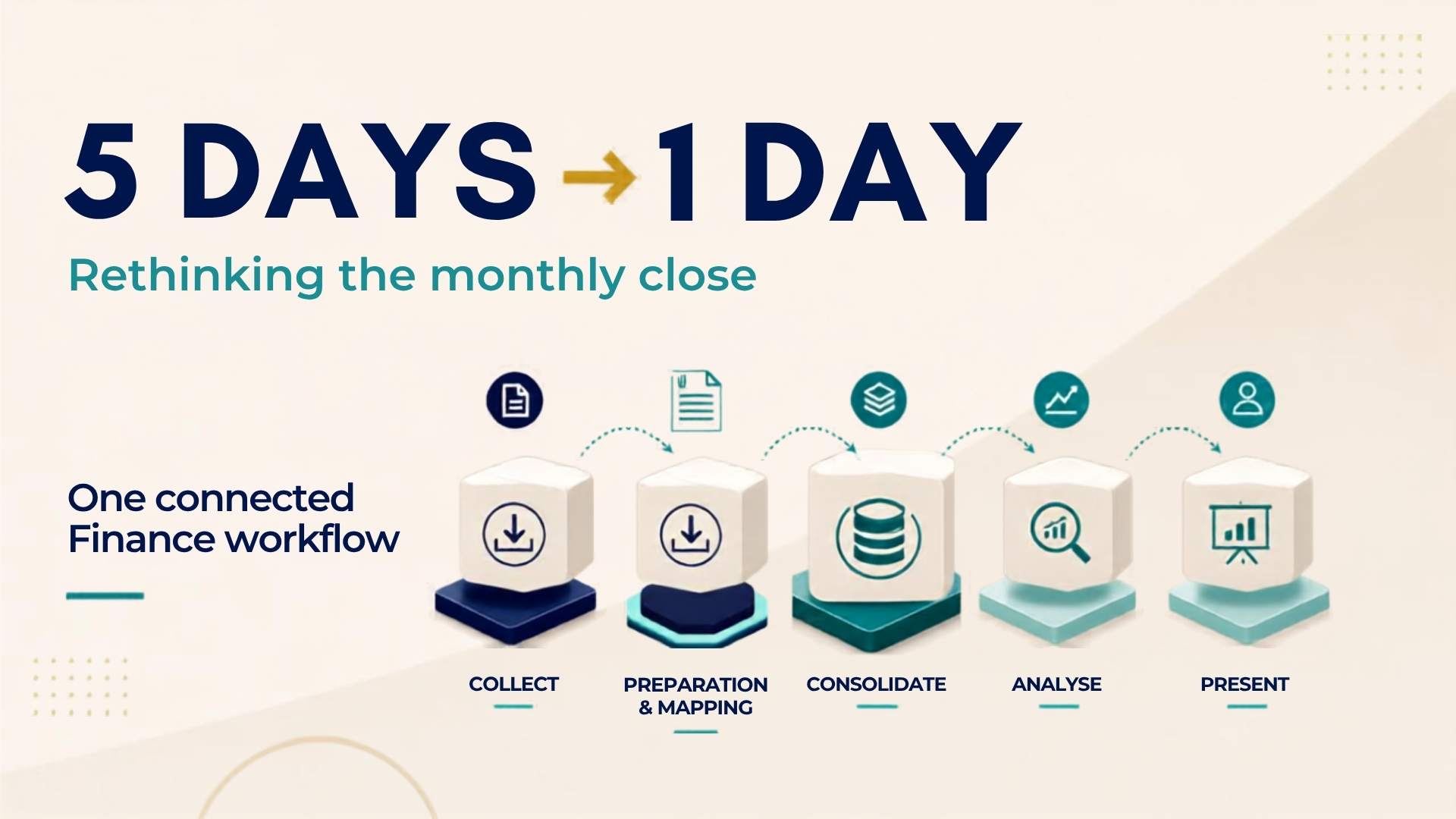
Sequential close
Connected close
Where does the time actually go?
A multi-entity close contains many manageable tasks. The delay comes from their dependencies: late data delays mapping, mapping delays consolidation, unresolved differences delay analysis, and final numbers delay the management pack.
| Work area | Why it delays the close | Redesigned response |
|---|---|---|
| Data readiness and mapping | Different exports, local accounts, languages, dimensions, and sign conventions | Normalize inputs, detect new accounts, reuse approved mappings, and review exceptions |
| FX, journals, and consolidation | Repeated preparation and calculations spread across workbooks | Run visible FX, matching, elimination, and consolidation rules, then review and post consolidation journals on governed inputs |
| Intercompany reconciliation | Differences appear late and trigger investigation after consolidation | Match as soon as both entities publish and surface likely causes early |
| Controls and approval | Status is tracked in email, checklists, and individual memory | Show readiness, failed controls, open exceptions, owners, and approvals together |
| Analysis and commentary | Controllers search manually for material movements before explaining them | Prioritize unusual variances and draft commentary for finance review |
| Management reporting | Numbers, charts, and comments are copied into PowerPoint and updated again | Create the pack from the same reviewed data and analysis |
The biggest gain comes from finding problems earlier—not discovering them at the end.
Turn five hand-offs into one governed workflow
Finance AI should not replace financial control. It should connect the work around that control, automate repeatable steps, and direct people to the decisions that need professional judgement.
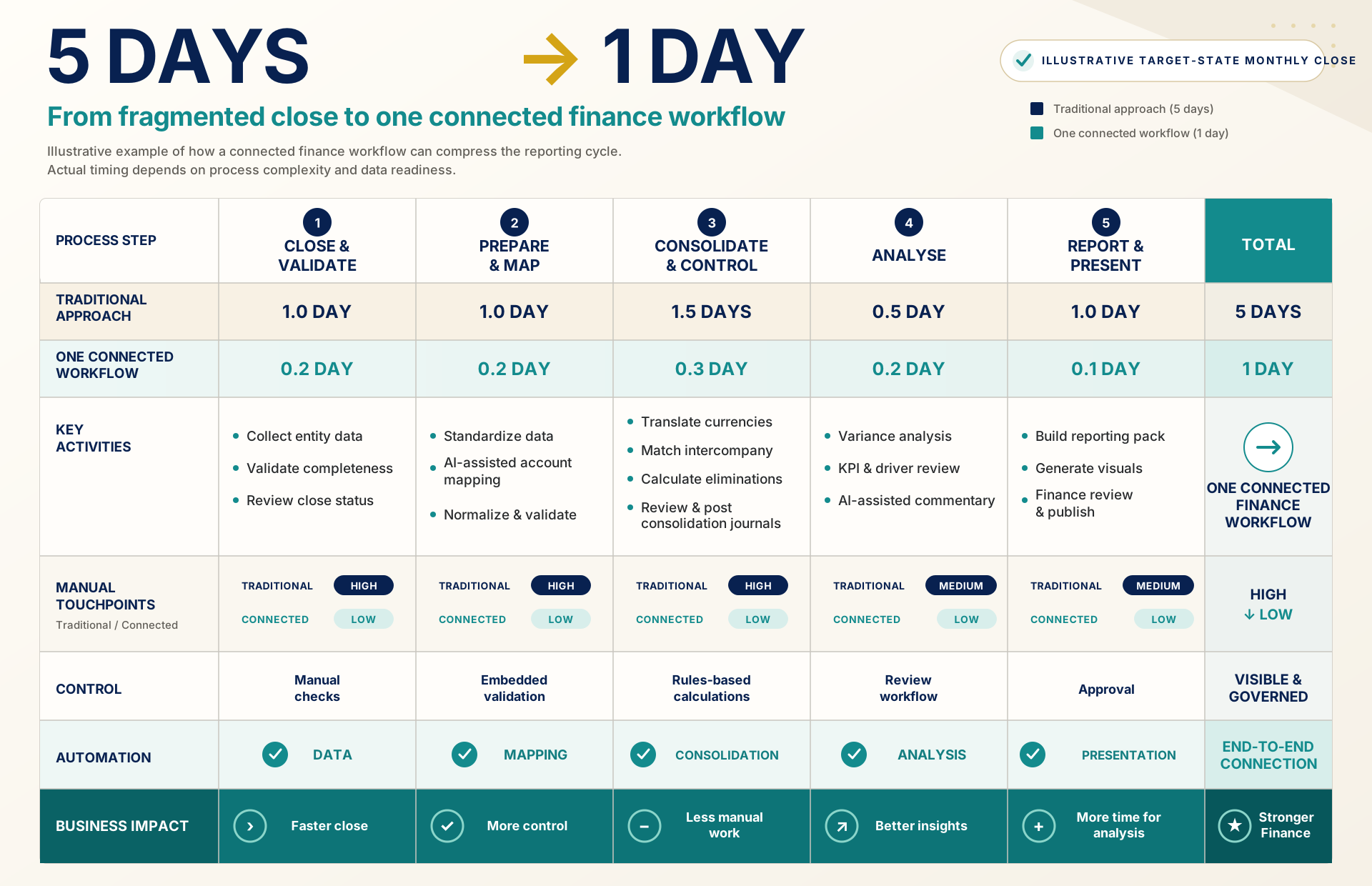
| Stage | What changes | Control that remains | Workflow |
|---|---|---|---|
| Close and validate | Collect entity data, validate completeness, and make close status visible. | Finance owns submission readiness, open items, and the decision to proceed. | Monthly Close |
| Prepare and map | Standardize incoming data, detect new accounts, and propose reusable mappings. | Finance reviews uncertain mappings and publishes the approved version. | Data Preparation AI, Account Mapping AI |
| Consolidate and control | Run controlled FX translation, intercompany matching, eliminations, and consolidation logic. | Rules calculate; Finance reviews exceptions, approved adjustments, and the consolidated result. | Consolidation Lite |
| Analyse | Rank material entity, group, and segment movements and draft initial commentary. | Finance confirms the evidence, explanation, and management conclusion. | Variance Analysis |
| Report and present | Turn reviewed figures and commentary into a reusable management presentation. | Finance edits and approves the pack before it is shared. | Presentation Studio |
What could a one-day close look like?
The target becomes credible when preparation happens before the deadline, reliable calculations run on governed data, and teams resolve exceptions as soon as they appear.
This example assumes that preparation begins before the reporting deadline and that approved mappings, controls, and rules are already in place.
Morning · Calculate
Publish validated data, apply mappings, translate FX, match intercompany balances, and consolidate.
Midday · Review
Resolve material differences, review and post consolidation journals, review eliminations, rerun calculations, and clear controls.
Afternoon · Explain
Review entity and group variances, approve commentary, and prepare the management presentation.
Keep the responsibilities clear
Closing faster should never make the result harder to explain. The safest design separates probabilistic assistance, deterministic calculation, and accountable approval.
AI assists
- interpret new accounts
- suggest mappings
- rank unusual movements
- draft commentary
Rules calculate
- translate currencies
- run consolidation logic
- match and reconcile
- execute finance controls
Finance decides
- approve mappings
- resolve exceptions
- review and post journals
- confirm conclusions
- publish reporting
When is the one-day target realistic?
- entity deadlines and ownership are clear
- source data is consistent enough to validate automatically
- approved mappings and rules are reused each month
- intercompany matching starts before the final consolidation
- materiality and approval policies are explicit
- analysis and the presentation use the reviewed close data
- late or incomplete entity reporting
- unclear accounting policies or ownership
- unresolved source-system data quality issues
- highly complex acquisition or statutory requirements
- controls that have no defined reviewer or evidence
- a process that changes without governance each month
Start by measuring wait time, rework, exception volume, and review effort—not only the number of calendar days. Those measures reveal which part of the close should be redesigned first.
Frequently asked questions
Finance AI and the monthly close
Concise answers about the one-day target, automation, and finance control.
Can Finance AI really cut a five-day close to one day?
It can help a suitable finance team move toward a one-day operating model by removing repeated preparation, surfacing exceptions earlier, and connecting consolidation, analysis, and reporting. The result depends on source-data readiness, group complexity, controls, and how much of the process can safely run in parallel.
What should AI do in the monthly close?
AI is best used to interpret new accounts, support mapping proposals, rank unusual movements, suggest possible drivers, and draft commentary. These outputs should remain reviewable and should not replace deterministic finance calculations or approval.
What should be calculated with deterministic rules?
Currency translation, consolidation calculations, eliminations, reconciliations, and financial controls should use visible, repeatable rules. Finance should be able to trace the inputs, logic, exceptions, and result.
What does Finance still need to approve?
Finance remains responsible for mappings, adjustments, exceptions, accounting conclusions, commentary, and published reporting. The aim is to focus professional judgement on decisions rather than repetitive preparation.
Is this only for management reporting, or can it support statutory consolidation?
The connected workflow supports a controlled group close across preparation, consolidation, analysis, and reporting. Consolidation Professional is now available in Early Access for more demanding workflows with consolidation journals, versioned group statements, traceability, review, and release controls.
From hand-offs to one workflow
Map the bottlenecks in your monthly close.
Review the current process, identify the largest delays, and evaluate which steps can be automated, parallelized, or moved to exception-based review.
Explore the connected workflow
The connected close is not one feature. It is a governed workflow across these modules:
Important note
A one-day close is an illustrative target operating model, not a guaranteed outcome. Actual timing depends on data readiness, group complexity, accounting requirements, controls, and implementation scope.
Some NorthernClarity group reporting and Presentation Studio capabilities are in Early Access.