Four breakthroughs—and the next shift
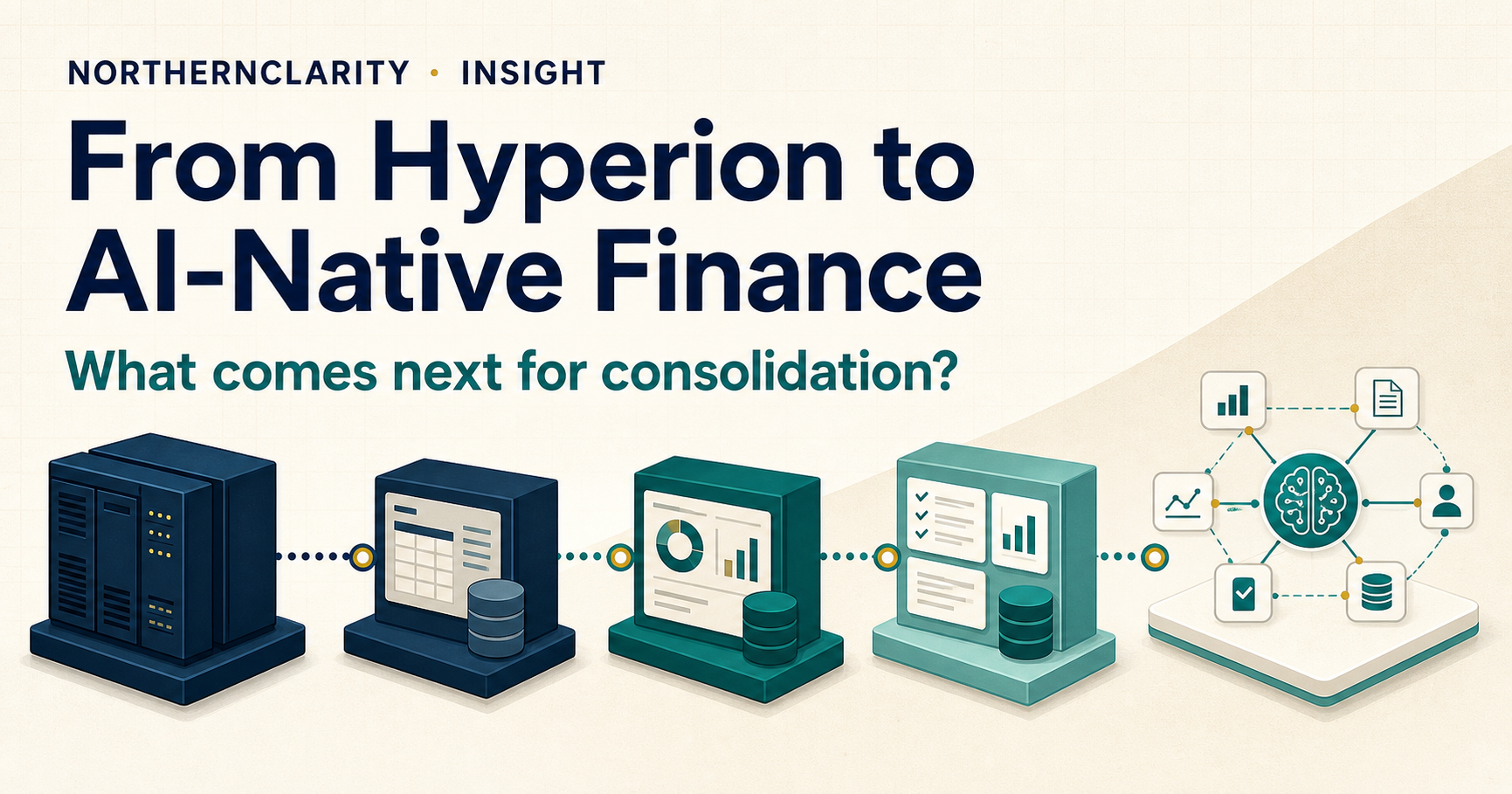
The evolution of financial consolidation is best understood as a series of architectural advances—not a product ranking or a strict replacement timeline.
Hyperion Enterprise made consolidation a dedicated finance application. HFM added scalable workflows, auditability and finance-owned control. Oracle FCCS brought consolidation into connected cloud EPM, while OneStream unified consolidation, planning, reporting and analytics on one platform.
These platforms continue to evolve and increasingly incorporate AI. The next shift is therefore not about replacing established systems. It is about extending governed intelligence across the preparation, investigation and reporting work that still surrounds the consolidation engine.
The consolidation engine solved the calculation problem—not the workflow problem
For many growing groups, the greatest friction exists at the boundaries of the consolidation system.
Subsidiaries may use different ERPs, languages, charts of accounts and sign conventions. Trial balances arrive in Excel or CSV files with varying structures. Local accounts must be mapped to a group model. Intercompany differences need to be identified, assigned and explained. Controllers then move from consolidation into separate spreadsheets, BI tools and presentation files to analyse performance and prepare the management pack.
The calculation engine may work exactly as designed while the end-to-end process remains fragmented.
How can finance turn varied local data into a controlled, explainable and management-ready group result—without surrounding the consolidation engine with recurring manual work?
That is where AI can create meaningful value: not by taking responsibility for the reported numbers, but by assisting with the ambiguous, repetitive and interpretive work that conventional rules handle poorly.
Three levels of AI inside a finance system
The term “AI-powered” covers very different operating models. A useful classification is to ask how deeply AI participates in the controlled finance process.
AI outside the finance workflow
AI is used in separate analysis and commentary tools.Finance moves data or questions outside the controlled workflow, then brings the output back for review.
AI embedded in selected tasks
AI supports individual reporting or analysis steps.The system drafts a narrative, highlights an anomaly or assists with a selected report, forecast or variance.
Governed AI across the workflow
AI supports the process inside finance-controlled guardrails.AI assists the process from data to reporting while calculations, review points and approvals remain controlled by finance.
AI maturity in finance should not be measured by how much judgement is delegated to AI. It should be measured by how broadly governed intelligence supports the workflow while calculations and approvals remain controlled by finance.
AI assists, rules calculate, finance decides
An AI-native finance architecture becomes clearer when assistance, calculation and accountability are separated explicitly.
| Governed AI assistance | Deterministic finance logic | Controller responsibility |
|---|---|---|
| Interpret source files | Currency translation | Review exceptions |
| Propose mappings | Aggregation and ownership logic | Approve mappings |
| Detect anomalies | Reconciliations and control totals | Approve eliminations |
| Explain intercompany differences | Post approved calculations | Approve accounting judgements |
| Draft analysis | Produce repeatable results | Publish final reporting |
AI handles ambiguity and interpretation. Rules produce repeatable financial results. Finance remains accountable for exceptions, accounting judgements and publication.
How NorthernClarity is building for the next era
NorthernClarity applies this division of responsibilities to the source-to-report challenges faced by growing groups. The workspace connects preparation, mapping, validation, consolidation, analysis and reporting without asking AI to replace controlled finance logic.
Prepare varied source data
Data Preparation AI is designed to interpret different ERP exports, Excel files and CSV structures. Detected structures, assumptions, exclusions and corrections remain reviewable before the data continues.
Outcome: Import-ready data
Map local accounts into a group model
Account Mapping AI proposes local-to-group mappings with confidence, rationale and risk signals. Approved mappings remain controlled master data: AI proposes; finance reviews and decides.
Outcome: Approved mappings
Validate before consolidation
Validation identifies structural issues, sign inconsistencies, missing fields, mapping gaps and reconciliation exceptions before they flow into the group result.
Outcome: Validated trial balance
Run a controlled group close
Consolidation Lite, currently in Early Access, brings together multi-entity collection, reviewed exchange rates, currency translation, intercompany matching, suggested eliminations, controller approval and group reporting. The calculations remain deterministic.
Outcome: Controlled group result
Understand what changed
Variance Analysis, Estimate & Forecast and AI Advisor use reviewed finance context to identify material movements, explore possible drivers, test questions and support forward-looking discussion.
Outcome: Reviewed explanations
Turn reviewed results into management reporting
Management Reporting connects validated figures, analysis and controller-approved commentary into executive summaries, actions and repeatable management-ready report packs.
Outcome: Management-ready pack
NorthernClarity Finance AI Workspace
AI-assisted data preparation, account mapping, analysis and management reporting—combined with deterministic consolidation, controller approvals and source-to-report traceability.
Who is this model built for?
The most immediate fit is a growing multi-entity group that has outgrown spreadsheet-based consolidation but does not need the cost, scope or implementation complexity of a broad enterprise EPM programme. It typically has several entities, currencies or local charts of accounts and recurring mapping, intercompany, analysis and management-reporting work.
Large or highly complex groups may continue to require the statutory depth and global scale of Oracle, OneStream or another enterprise platform. A focused AI-native workspace serves a different need: improving the practical group close without making the technology programme larger than the finance problem.
The workflow around consolidation is the next opportunity
Established consolidation platforms created the controlled calculation foundation. The next opportunity is to bring the work around that foundation into one connected, finance-governed process.
Consolidation systems solved the calculation problem. NorthernClarity is being built to make the entire workflow around it more intelligent, controlled and traceable.
Frequently asked questions
AI-native financial consolidation FAQ
Open a question for a concise answer.
What is an AI-native consolidation workflow?
It is a source-to-report workflow in which governed AI assists tasks such as data preparation, mapping, validation, investigation, analysis and reporting. Financial calculations and final approvals remain deterministic and finance-controlled.
Does AI calculate the consolidated group result?
It should not replace explicit consolidation logic. Currency translation, ownership calculations, aggregations, eliminations and control totals should remain repeatable and auditable. AI is better used for interpretation, classification, exception investigation and drafting.
How is NorthernClarity different from enterprise EPM?
NorthernClarity is being built around a narrower, lighter operating model for growing groups. It focuses on the practical flow from varied entity data to controlled group reporting, analysis and management reporting. Enterprise EPM platforms offer broader depth for large and highly complex organisations.
Product and market note
This article describes an architectural direction and NorthernClarity's product vision. Early Access modules and roadmap items may change as the product develops. Product names and trademarks belong to their respective owners; the evolution graphic is representative, not a product ranking or strict replacement timeline.