Lightweight refers to implementation and operating complexity — not to the importance of financial controls.
What is lightweight financial consolidation?
Lightweight financial consolidation sits between an Excel-based process and a broad enterprise performance management platform. It gives finance a structured monthly workflow without requiring every capability, configuration option, and administration layer of a full enterprise suite.
More repeatable control
Mappings, translation, matching, review, and approvals move out of linked files.
A narrower operating scope
The implementation focuses on the recurring group reporting process actually needed.
Finance remains accountable
Validation, review, approval, reconciliation, and traceability are still required.
The objective is practical monthly consolidation: reliable entity inputs, consistent group mappings, controlled FX translation, visible intercompany differences, reviewed eliminations, and management-ready group reports.
Excel is rarely the problem. The challenge is the uncontrolled process around it.
Excel remains flexible, familiar, and valuable. Problems usually appear when the consolidation process grows faster than the controls around the workbook. More entities, currencies, counterparties, and reviewers create handoffs that are hard to standardize and even harder to trace under month-end pressure.
- different local charts of accounts and sign conventions
- multiple file versions moving through email and shared folders
- manual currency translation formulas and rate checks
- intercompany differences that are difficult to resolve before close
- eliminations whose rationale is hard to trace later
- formula errors or broken links in recurring workbooks
- dependence on one person who understands the complete model
- limited visibility into how an entity balance becomes a group figure
A group does not need to abandon spreadsheets entirely. The more important change is to move the controlled process — inputs, mappings, calculations, exceptions, review, and approval — into a shared workflow.
When is enterprise EPM the right answer — and when may it be too much?
Enterprise EPM is the right choice for many organizations. A credible evaluation starts by recognizing where its additional depth is necessary and where a smaller group may otherwise carry more cost, implementation effort, and administration than its reporting model requires.
- ownership and consolidation structures are highly complex
- several reporting standards run in parallel
- statutory consolidation requirements are extensive
- user, entity, journal, and integration volumes are very large
- the organization needs deeply configurable workflows
- the ownership structure is relatively straightforward
- the primary need is recurring monthly group reporting
- several entities or currencies have outgrown linked workbooks
- finance needs stronger visibility, review, and repeatability
- a focused implementation is more proportionate than a platform program
Excel vs. lightweight consolidation vs. enterprise EPM
The most useful comparison is not a feature count. It is the fit between the group’s reporting complexity, required controls, implementation capacity, and desired operating model.
| Area | Excel-based process | Lightweight consolidation | Enterprise EPM |
|---|---|---|---|
| Initial setup | Fast but highly manual | Focused implementation | Longer implementation project |
| Data collection | Files and email | Controlled entity uploads | Integrated collection workflow |
| Account mapping | Spreadsheet formulas | Reusable mapping and validation | Highly configurable mapping |
| Currency translation | Manual formulas | Controlled FX translation | Extensive currency capabilities |
| Intercompany matching | Manual reconciliation | Matching and difference detection | Advanced matching and automation |
| Eliminations | Manual journals or formulas | Suggested and reviewed eliminations | Automated consolidation rules |
| Audit trail | Depends on file discipline | Workflow and approval history | Extensive audit and governance |
| Group reporting | Custom spreadsheets | Standardized group views | Highly configurable reporting |
| Best suited for | Very small or simple groups | Growing, straightforward groups | Large or complex groups |
“Lightweight” should not be read as “automatic” or “uncontrolled.” In a focused workflow, suggested eliminations still require finance review, and the system should make the approval history visible.
What does a lightweight consolidation workflow look like?
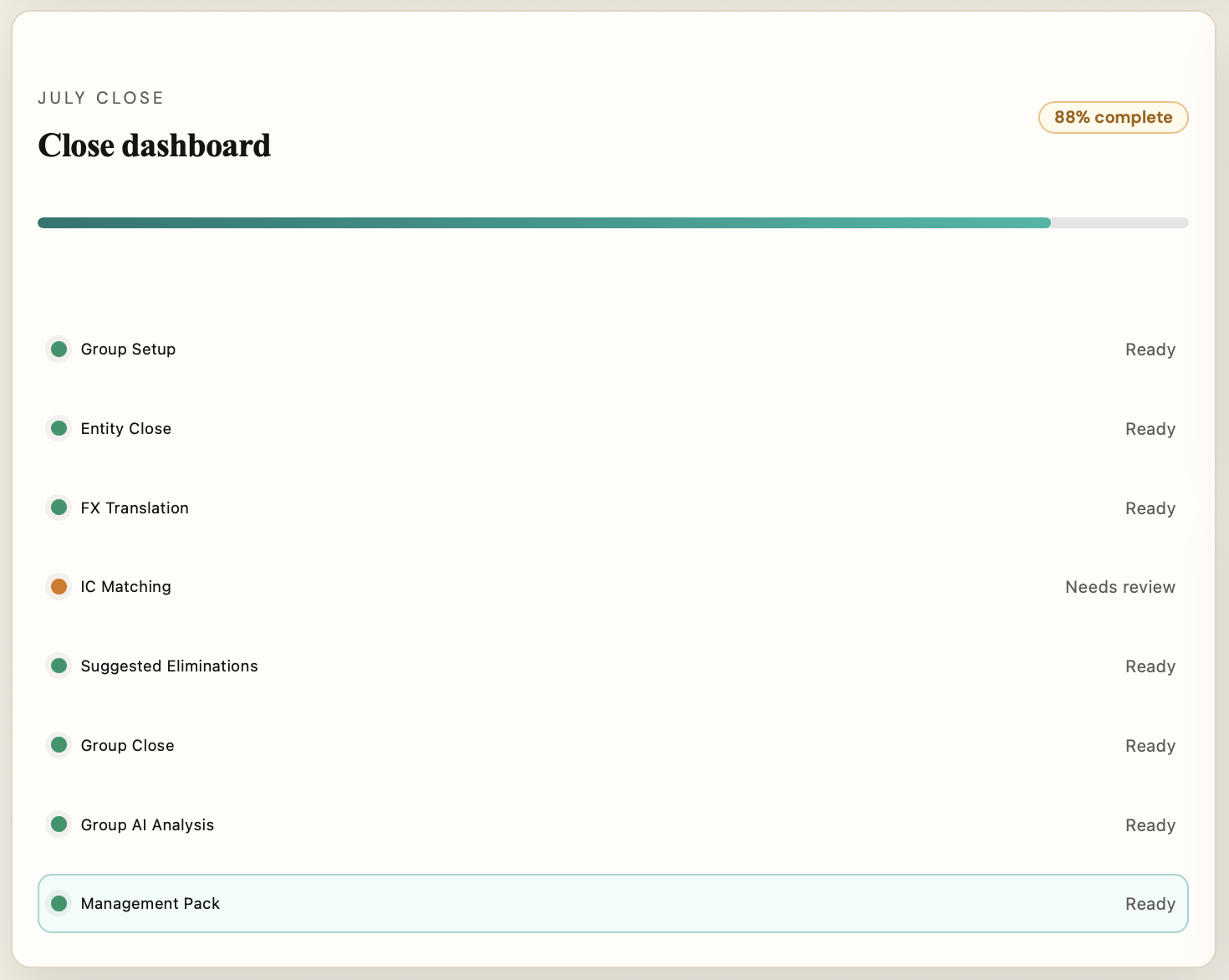
A well-designed workflow makes each transformation visible: what came from the entity, what the system changed, which exceptions were found, and what finance reviewed before group reporting.
- 01Entity data upload
Approved trial balances are collected with a clear entity, period, currency, and source context.
- 02Account mapping and sign normalization
Local accounts are mapped into a reusable group structure and sign conventions are validated.
- 03Currency translation
Foreign-entity balances are translated using visible, reviewed rate sets and methods.
- 04Intercompany matching
Counterparty balances are compared and differences are surfaced before elimination.
- 05Suggested eliminations and review
Elimination proposals are prepared with supporting detail for controller review and approval.
- 06Group financial statements
Reviewed entity data, translations, and eliminations form standardized group-level views.
- 07Group variance analysis and estimate
Finance can explain movements, compare actuals with expectations, and identify follow-up items.
- 08Management pack export
Approved group analysis is turned into repeatable management reporting outputs.
How does consolidation connect to the monthly close and management reporting?
Consolidation is one controlled step in the wider close-to-report process. The reviewed group result can move into AI-assisted monthly close reporting, where Finance validates movements and commentary, then into automated variance analysis with evidence and Presentation Studio for management reporting.
The practical operating model is described in How to Cut the Monthly Close from 5 Days to 1 with Finance AI. The one-day outcome is a target operating model, not a guaranteed timetable.
Example: a Nordic multi-entity group
Consider a Nordic group whose parent reports in euros. It has an operating company in Finland, a Swedish subsidiary reporting in SEK, and a Norwegian subsidiary reporting in NOK. The entities use different local charts of accounts and trade with each other through product sales, management fees, receivables, and payables.
Group parent
Reporting currency EUR and responsibility for the consolidated P&L and balance sheet.
Finnish entity
Local trial balance in EUR with its own chart of accounts and intercompany positions.
Swedish entity
Local trial balance in SEK requiring mapping, translation, and counterparty review.
Norwegian entity
Local trial balance in NOK with management fees and intercompany balances.
The value of the workflow is not simply that it adds the entities together. It creates a transparent chain from each approved local balance through mapping, translation, matching, and elimination to the final group figure. The controller can see where a difference originated and what was approved before the monthly pack was produced.
Who is lightweight consolidation suitable for?
- growing multi-entity groups
- finance teams moving beyond Excel-based consolidation
- groups operating in several currencies
- monthly management consolidation
- relatively straightforward ownership structures
- teams that need visibility and review controls
- groups seeking a faster implementation path than enterprise EPM
- highly complex statutory consolidations
- extensive automated consolidation journals
- multiple parallel accounting standards
- highly regulated reporting environments
- complex ownership changes and consolidation methods
The boundary matters. Choosing a lighter solution is sensible only when its scope matches the group’s reporting requirements and expected future complexity.
Evaluation checklist
Use these questions when comparing a workbook process, a lightweight consolidation product, or a broader EPM platform. The answers should be demonstrated in the actual workflow rather than left at feature-list level.
- Can users trace group figures back to entity-level data?
- Are account mappings reusable and reviewable?
- Are sign conventions validated before consolidation?
- Are currency rates and translation methods visible?
- Can intercompany differences be identified before elimination?
- Are eliminations reviewed and documented?
- Do group reports reconcile to approved inputs?
- Is there a clear approval and audit history?
- Can the output be used directly in management reporting?
How NorthernClarity Consolidation Lite approaches the problem
The Early Access direction focuses on:
- transparent raw-to-group data flow
- account mapping and sign normalization
- controlled currency translation
- intercompany matching and difference detection
- suggested eliminations with human review
- deterministic finance checks
- group variance analysis and estimates
- management pack workflow
The aim is a faster and lighter adoption path while keeping finance in control of mappings, exceptions, eliminations, validation, and publication. Early Access scope is tailored to the reporting process and should be evaluated against the group’s actual data, ownership model, and output requirements.
Frequently asked questions
Lightweight financial consolidation FAQ
Open a question for a concise answer or link directly to an individual topic.
What is lightweight financial consolidation software?
It is software designed to move a growing group beyond spreadsheet-only consolidation through controlled data collection, reusable account mapping, currency translation, intercompany matching, reviewed eliminations, and group reporting. “Lightweight” refers to implementation and operating complexity, not to weaker financial controls.
Can lightweight consolidation replace Excel?
It can replace the linked workbooks, manual handoffs, and recurring control steps that become difficult to manage as a group grows. Excel can still remain an input or analysis tool; the goal is to move the governed consolidation process into a repeatable workflow.
Is it suitable for statutory consolidation?
That depends on the group’s legal structure, reporting standards, ownership changes, and required consolidation methods. A lightweight solution can fit straightforward structures, but highly complex statutory consolidation may require an enterprise platform and specialist accounting assessment.
Does it support multiple currencies?
Multiple-currency group reporting is a core use case. A controlled workflow should make the applied rates, translation method, source currency, and reporting currency visible and reviewable.
How does intercompany matching work?
Entity balances are associated with counterparties, compared across the group, and presented in a matching queue. Finance reviews differences and resolves timing, classification, currency, or posting issues before elimination.
Are eliminations automated?
The appropriate level of automation depends on the product and use case. NorthernClarity Consolidation Lite uses suggested eliminations with human review: the system can prepare proposals, but finance remains responsible for validation and approval.
What is the difference between lightweight consolidation and EPM?
Lightweight consolidation focuses on a narrower, recurring group reporting workflow and a faster implementation path. Enterprise EPM platforms typically offer broader configuration, complex consolidation logic, planning, governance, and integration capabilities for large organizations.
When should a group move from Excel to consolidation software?
Common signals include repeated version-control problems, manual currency formulas, unresolved intercompany differences, difficult-to-trace eliminations, growing key-person dependency, and limited visibility from entity balances to group results.
From Excel to a controlled group close
Is your group between Excel and enterprise EPM?
Book a short discussion to evaluate whether a lightweight consolidation approach would fit your reporting process.
Related NorthernClarity pages
Important note
This guide describes common consolidation operating models and NorthernClarity’s Early Access product direction. Exact requirements depend on the group structure, reporting standards, jurisdictions, accounting policies, data, and deployment scope. This guide is not accounting, legal, or implementation advice.